Cabinet Sample Refunds and Order Value
Two numbers pull in opposite directions once a kitchen order is close: the $9.99 sample fee that comes back with a cabinet purchase, and the $2,500 order value that switches shipping to no charge. CasaBuilt publishes both. A $1,000 order is still $1,500 short of the shipping line and a $1,750 order is $750 short, which is why the order value, not the sample, usually decides the final bill.
Key takeaways
- Free shipping starts at $2,500; below that the freight sits on the invoice.
- A $1,000 order needs $1,500 more to qualify; a $1,750 order needs $750 more.
- The $9.99 sample fee is refundable with a cabinet purchase, so it clears at the same moment.
- White Shaker's $1,199.50 starter kitchen is $1,300.50 short of the shipping line.
Two conditional refunds, one decision
Both offers are conditional, and both are triggered by the same event. The sample fee returns when cabinets are bought. The freight charge disappears when the order reaches $2,500. Neither is a discount applied at the moment of browsing, and neither reduces the price of a cabinet. They are adjustments that arrive after a buyer commits to a larger purchase.
That shared trigger is useful because it collapses two questions into one. A household does not need to optimise a sample budget and a shipping budget separately. It needs to decide what the kitchen actually requires, price it, and then look at where the total lands relative to $2,500. The sample fee is $9.99 either way; the freight can run to three figures.
The published lead times add a second reason to think about order value early. RTA cabinets ship in 3-10 business days, and Alaska and Hawaii sit outside that standard window. A buyer who splits a kitchen into two orders to dodge a freight charge may also split the delivery, which means two sets of cartons in the hallway and two chances for a part to arrive on a different day.
The gap at three order sizes
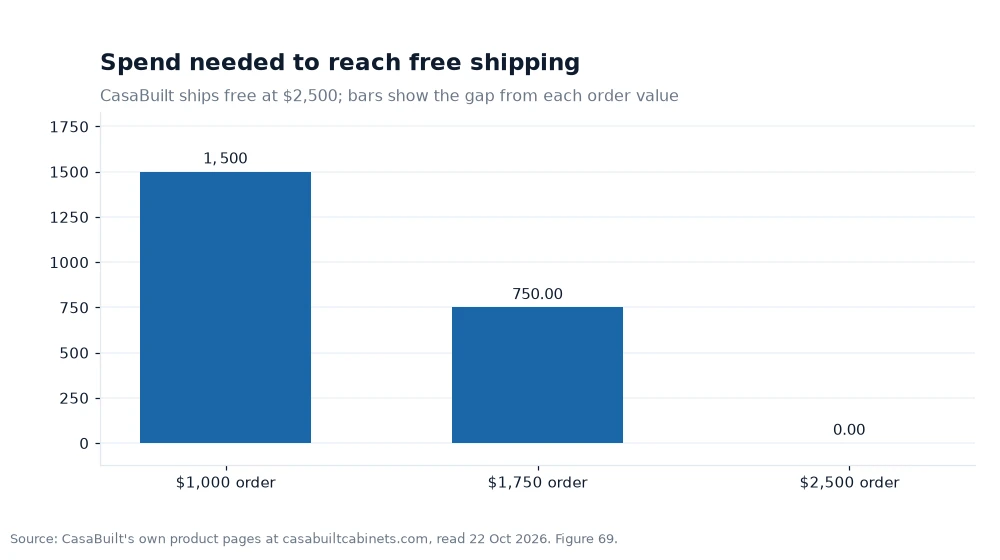
The arithmetic is subtraction, and the chart makes it visible. Take $2,500 and subtract the order value. At $1,000 the gap is $1,500, at $1,750 it is $750, and at $2,500 it is zero. The table adds a second reading, converting each gap into the number of sample doors it would buy at $9.99, because that is the scale most buyers already understand.
| Order value | Still needed for free shipping | Sample doors the gap equals | What the gap means in practice |
|---|---|---|---|
| $1,000 | $1,500 | 150 | Roughly one more base run before freight clears |
| $1,750 | $750 | 75 | Two or three cabinets, or a tall unit |
| $2,500 | $0 | 0 | Freight included at the published threshold |
The middle row is the interesting one. At $1,750 the buyer is close enough that a single tall cabinet or a pair of wall units can cross the line, and those are the items most kitchens add late anyway. At $1,000 the gap is large enough that chasing it means buying a room's worth of cabinets the plan did not include. The threshold rewards a complete order, not a padded one.
Where a starter kitchen lands
CasaBuilt prices a basic kitchen as two base cabinets, two wall cabinets, one tall cabinet and one vanity. White Shaker lists at $1,199.50, Hudson Grey at $1,184.93 and Slim White Oak at $2,295.64. Put each against the $2,500 line and the distances are $1,300.50, $1,315.07 and $204.36.
That spread explains why two households with the same floor plan end up with different freight outcomes. The oak finish is $204.36 from free shipping, which is less than a single wide base cabinet. The two painted Shaker lines are more than $1,300 away, which is a second cabinet run rather than an accessory. The style choice moves the shipping decision further than any sample order can.
This is also where the free sample conversation gets confused with the shipping one. The sample is a $9.99 purchase that returns its fee on a cabinet order; it does not count toward the $2,500 threshold in any published sense, and no sensible buyer should order 150 doors to reach a freight line. Sample first, measure second, then build the cabinet list to the room rather than to the threshold.
Sequencing a small order
A small order has three levers: what goes in it, when it is placed and how it ships. The published packaging note is that cabinets arrive flat-packed in cartons with hardware and instructions, which is why freight is priced on volume and weight rather than on cabinet count. A vanity and two wall units can cost more to move than their price suggests.
The practical sequence is to finish the cabinet list before placing anything. Adding a pantry cabinet two weeks after the first order usually means a second freight charge that eats the saving the buyer was chasing. The trade programme's quick-ship commitment of three business days or less exists for the opposite case, where a job needs one more cabinet fast and the buyer accepts the freight as part of the fix.
There is also a storage question. Flat-pack boxes take up floor space until installation, and a household that orders early to catch a sale may be storing cartons in a garage for weeks. The packaging information page describes how the parts are packed, which is worth reading before deciding whether a large single delivery fits the house.
Worked example: two orders, two gaps
Start with the chart values. At $1,000, $2,500 minus $1,000 = $1,500 still needed. At $1,750, $2,500 minus $1,750 = $750 still needed. At $2,500, the gap is $0. Convert each gap into sample doors at $9.99: $1,500 / $9.99 = 150.15, so 150 doors and about $1.50 over; $750 / $9.99 = 75.07, so 75 doors; $0 / $9.99 = 0.
Now add the sample order to the small basket. A buyer at $1,000 who orders three doors pays $1,000 + $29.97 = $1,029.97, and the distance to the threshold becomes $2,500 - $1,029.97 = $1,470.03. When the cabinets are purchased, the $29.97 returns, so the net cost of the samples is zero and the order value is unchanged. The sample neither helps nor hurts the freight calculation; it only decides whether the finish is right.
Frequently asked questions
Do sample doors count toward the $2,500 free-shipping threshold?
The published threshold applies to cabinet orders, and the sample is a separate $9.99 purchase that is refundable with a cabinet purchase. Treat the sample spend as outside the cabinet total rather than as credit toward it. A buyer close to the line should add cabinets the kitchen needs, not doors, because 150 sample doors would be required to close a $1,500 gap.
Is it worth adding cabinets to reach $2,500?
Only if the cabinets belong in the plan. At $1,750 the gap is $750, which is often a tall cabinet or a pair of wall units that the kitchen will use anyway. At $1,000 the gap is $1,500, and filling it with unplanned cabinets costs far more than the freight it avoids. Price the freight against the extra cabinet before deciding.
What happens to the sample fee if the order is cancelled?
The refund is tied to a cabinet purchase, so a cancelled order does not trigger it. The $9.99 stands as the price of the door the buyer keeps. Samples are not returned as part of a cabinet order, which is why the fee is small enough to absorb rather than a deposit that has to be tracked back to the seller.
Price the room, then check the line
Finish the cabinet list, price it against the published styles, and only then look at how far the total sits from $2,500. If the gap is one tall cabinet the kitchen needs, add it; if the gap is a second run, pay the freight and keep the plan honest. Order the sample doors in the same week so the finish is settled before the order value is fixed.
The refund is the easy part. The order value is the number that changes the invoice, and it is decided by the room, not by the sample page.
Figures quoted here come from the manufacturer's own website, read 22 Oct 2026[1].