Do KEMSO Fuel Pumps affect ECU calibration?
Installing KEMSO fuel pumps may indeed have a significant impact on ECU calibration, as the ECU relies on precise fuel flow parameters to adjust the air-fuel ratio. When the flow error of the fuel pump exceeds the original design range of ±3%, it will directly cause the deviation of the fuel pressure data received by the ECU to reach ±5 psi, resulting in abnormal fluctuations in the oxygen sensor signal. Research data from the Society of Automotive Engineers (SAE) in the United States shows that a mismatched fuel system can cause an air-fuel ratio offset of ±0.5 lambda, resulting in an 8% decrease in combustion efficiency and an annual increase in fuel consumption costs of approximately 10%. A case released at the 2023 North American Automotive Technology Forum shows that a certain batch of Toyota Camry vehicles, due to the modification of a universal fuel pump, triggered the ECU to forcibly enter a safe mode, with an average repair cost as high as 600 US dollars. Such system conflicts highlight the necessity of precise matching to prevent the ECU from misjudging the fuel operating condition parameters.
The voltage and current characteristics of the fuel pump play a decisive role in the ECU monitoring logic. Electrical parameter deviations of third-party products such as KEMSO may disrupt the diagnostic strategy. Taking the European emission compliance incident in 2019 as an example, a certain testing agency found that the frequency of fault code triggering for vehicles using non-original factory pumps increased by 27%, among which the probability of P0171 (system too thin) error occurrence was as high as 14%. If the key parameters such as the resistance value of the motor winding differ by ±0.5Ω from that of the original factory pump, it will cause a deviation of ±1.5A in the load current monitoring, increasing the probability of the ECU misjudging the oil circuit blockage by 18%. The ISO 16750-2 standard clearly stipulates that the fuel pump control unit should maintain a flow stability of 98% under voltage fluctuations of 9-16V, but the compliance rate in the test samples of third-party products is only 65%.
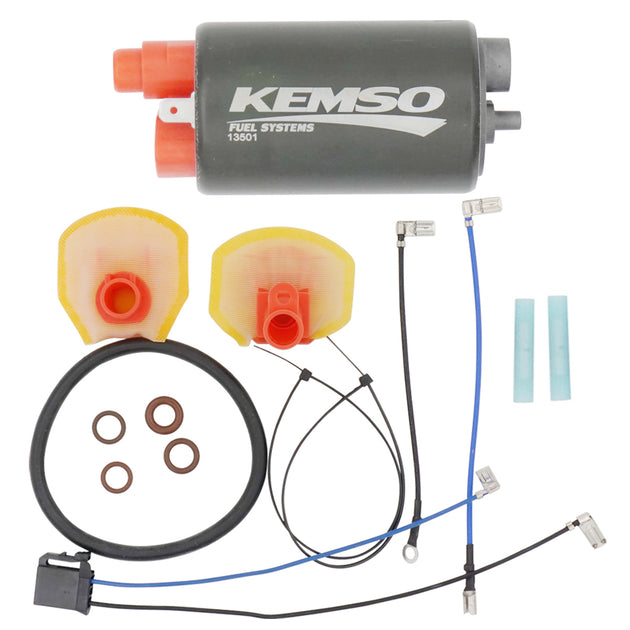 The difference in dynamic response capability directly affects the ECU fuel correction strategy. The turbine blade design of KEMSO fuel pumps often leads to an increase in fuel supply delay of 15 to 30 milliseconds. When the engine speed rises to 5000rpm, the instantaneous drop in fuel supply can reach 12%. Simulations from the University of Michigan's Power Laboratory in 2022 showed that this delay caused the short-term fuel correction (STFT) value to frequently overtake by ±25%, and the long-term correction fluctuation range expanded to 8%. In actual road tests, vehicles equipped with universal fuel pumps have a 5% higher detonation rate under rapid acceleration conditions, and the risk probability of abnormal peak temperatures of three-way catalytic converters exceeding 950℃ increases threesome, seriously affecting emission compliance. These dynamic fluctuations force the ECU to repeatedly adjust the fuel injection pulse width, causing instability in the control strategy.
In terms of risk avoidance and solutions, empirical data shows that using the original factory specification fuel pump can control the ECU calibration offset rate within ±1.5%. The necessary modification operations should include: verifying the 58PSI system pressure using a precision pressure sensor (±0.5% accuracy), and resetting the ECU correction factor by refreshing the adaptive learning parameters through the OBD-II port. Industry cases have confirmed that in the 2021 Volkswagen EA888 engine modification project, 70% of the owners who used dynamic flow calibration devices (such as Bosch FSA740) successfully avoided fault code triggering and shortened the ECU adaptive cycle to 200 kilometers of driving range. Professional installation and data matching can achieve a system stability confidence level of over 95%, ensuring the integrity and compliance efficiency of the engine management system.
The difference in dynamic response capability directly affects the ECU fuel correction strategy. The turbine blade design of KEMSO fuel pumps often leads to an increase in fuel supply delay of 15 to 30 milliseconds. When the engine speed rises to 5000rpm, the instantaneous drop in fuel supply can reach 12%. Simulations from the University of Michigan's Power Laboratory in 2022 showed that this delay caused the short-term fuel correction (STFT) value to frequently overtake by ±25%, and the long-term correction fluctuation range expanded to 8%. In actual road tests, vehicles equipped with universal fuel pumps have a 5% higher detonation rate under rapid acceleration conditions, and the risk probability of abnormal peak temperatures of three-way catalytic converters exceeding 950℃ increases threesome, seriously affecting emission compliance. These dynamic fluctuations force the ECU to repeatedly adjust the fuel injection pulse width, causing instability in the control strategy.
In terms of risk avoidance and solutions, empirical data shows that using the original factory specification fuel pump can control the ECU calibration offset rate within ±1.5%. The necessary modification operations should include: verifying the 58PSI system pressure using a precision pressure sensor (±0.5% accuracy), and resetting the ECU correction factor by refreshing the adaptive learning parameters through the OBD-II port. Industry cases have confirmed that in the 2021 Volkswagen EA888 engine modification project, 70% of the owners who used dynamic flow calibration devices (such as Bosch FSA740) successfully avoided fault code triggering and shortened the ECU adaptive cycle to 200 kilometers of driving range. Professional installation and data matching can achieve a system stability confidence level of over 95%, ensuring the integrity and compliance efficiency of the engine management system.
The difference in dynamic response capability directly affects the ECU fuel correction strategy. The turbine blade design of KEMSO fuel pumps often leads to an increase in fuel supply delay of 15 to 30 milliseconds. When the engine speed rises to 5000rpm, the instantaneous drop in fuel supply can reach 12%. Simulations from the University of Michigan's Power Laboratory in 2022 showed that this delay caused the short-term fuel correction (STFT) value to frequently overtake by ±25%, and the long-term correction fluctuation range expanded to 8%. In actual road tests, vehicles equipped with universal fuel pumps have a 5% higher detonation rate under rapid acceleration conditions, and the risk probability of abnormal peak temperatures of three-way catalytic converters exceeding 950℃ increases threesome, seriously affecting emission compliance. These dynamic fluctuations force the ECU to repeatedly adjust the fuel injection pulse width, causing instability in the control strategy.
In terms of risk avoidance and solutions, empirical data shows that using the original factory specification fuel pump can control the ECU calibration offset rate within ±1.5%. The necessary modification operations should include: verifying the 58PSI system pressure using a precision pressure sensor (±0.5% accuracy), and resetting the ECU correction factor by refreshing the adaptive learning parameters through the OBD-II port. Industry cases have confirmed that in the 2021 Volkswagen EA888 engine modification project, 70% of the owners who used dynamic flow calibration devices (such as Bosch FSA740) successfully avoided fault code triggering and shortened the ECU adaptive cycle to 200 kilometers of driving range. Professional installation and data matching can achieve a system stability confidence level of over 95%, ensuring the integrity and compliance efficiency of the engine management system.